Healthy building and living

For us, healthy building and living starts with the choice of materials. The MaWood Home system combines timber and clay with carefully considered planning. Here we present our concept and the materials we use.
The concept of healthy, sustainable building means creating buildings and interiors that promote occupants’ health and wellbeing while minimising their impact on the environment. What our ancestors took for granted must now be rediscovered. Combining traditional knowledge with modern building technology makes it possible to create fully ecological homes that meet modern clients’ expectations in every respect.
With the MaWood-Home® system, you build sustainably and healthily with many advantages:
Indoor air quality

Good indoor air quality is essential to occupants’ lasting health. We use pollutant-free building materials, with tests showing that they do not release pollutants into living spaces. The materials timber and clay support indoor air quality by allowing the building to breathe and buffering odours and humidity through their sorption properties. MaWood-Home® achieves this without installing a costly ventilation system requiring intensive maintenance.
Moisture control

Moisture can cause mould and allergic reactions. For health and wellbeing, it is therefore advisable to build a proportion of wall and ceiling surfaces in clay , as this balances relative humidity at around 50% and is particularly beneficial to health , especially for people with respiratory conditions. Integrating climate-control elements can enhance this effect.
Noise protection

Noise can cause stress and affect occupants’ health. Thanks to solid timber construction , cavities are almost completely avoided. The overall wall build-up thus offers little surface for transmitting sound waves. Clay adds substantial mass, which reliably absorbs sound. Together, these measures reduce indoor noise and help provide the peace the body needs for optimal recovery.
Environmentally friendly materials

Choosing the right building materials is crucial. Natural, ecological materials benefit both users and the house, especially during conversion, dismantling and recycling. Easily separable, recyclable components can avoid high special-disposal costs and allow materials to be reused. Low processing requirements and short transport routes also help minimise CO₂ emissions and ensure lasting environmental compatibilityfrom raw material sourcing to demolition.
Tested quality

Almost all MaWood-Home® materials have been tested with the Sentinel-Haus certificate. This label confirms that the materials used are free of pollutants. Sentinel-Haus also continuously monitors product quality.

All insulation materials in our system have been tested by the Institute of Building Biology in Rosenheim for healthy living and environmental compatibility.

MaWood GmbH is a member of NaturePlus e.V., which supports healthy, ecological building and promotes research into relevant systems and materials.
Natural lighting
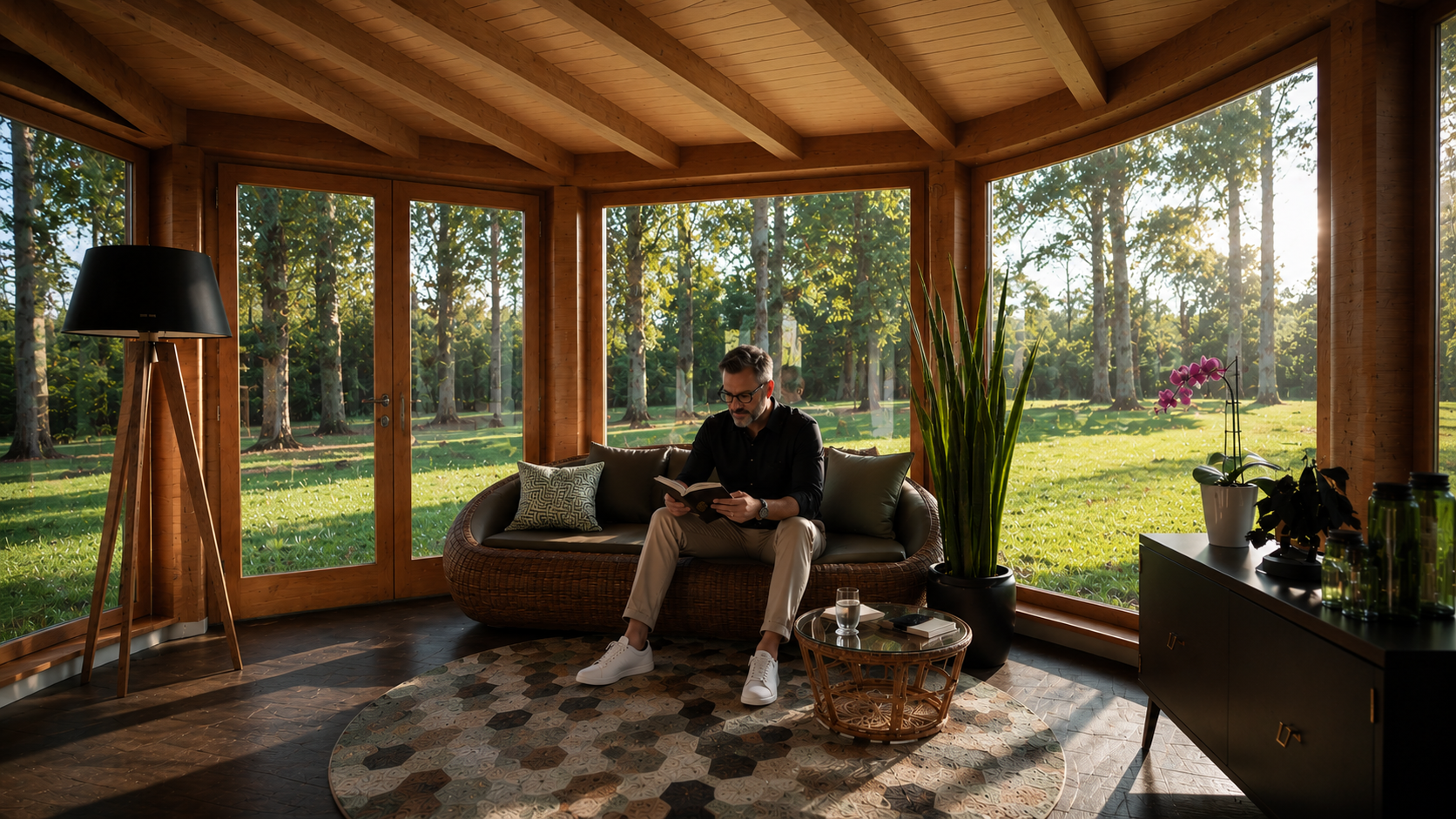
Daylight has proven positive effects on people. Large, correctly positioned windows enhance a room’s atmosphere. Solar radiation entering through them also warms the building alongside conventional heating and can save energy. A monolithic element such as a rammed-earth or clay wall (Fig. 1), exposed during the day, acts as a simple thermal buffer, slowly releasing heat back into the room.
The solar radiation at a location can now be calculated accurately and can theoretically influence heating-system sizing. Excessive solar gain must also be avoided to prevent overheating, especially in summer. Appropriate glazing selection allows fine adjustment.

Resource and energy efficiency
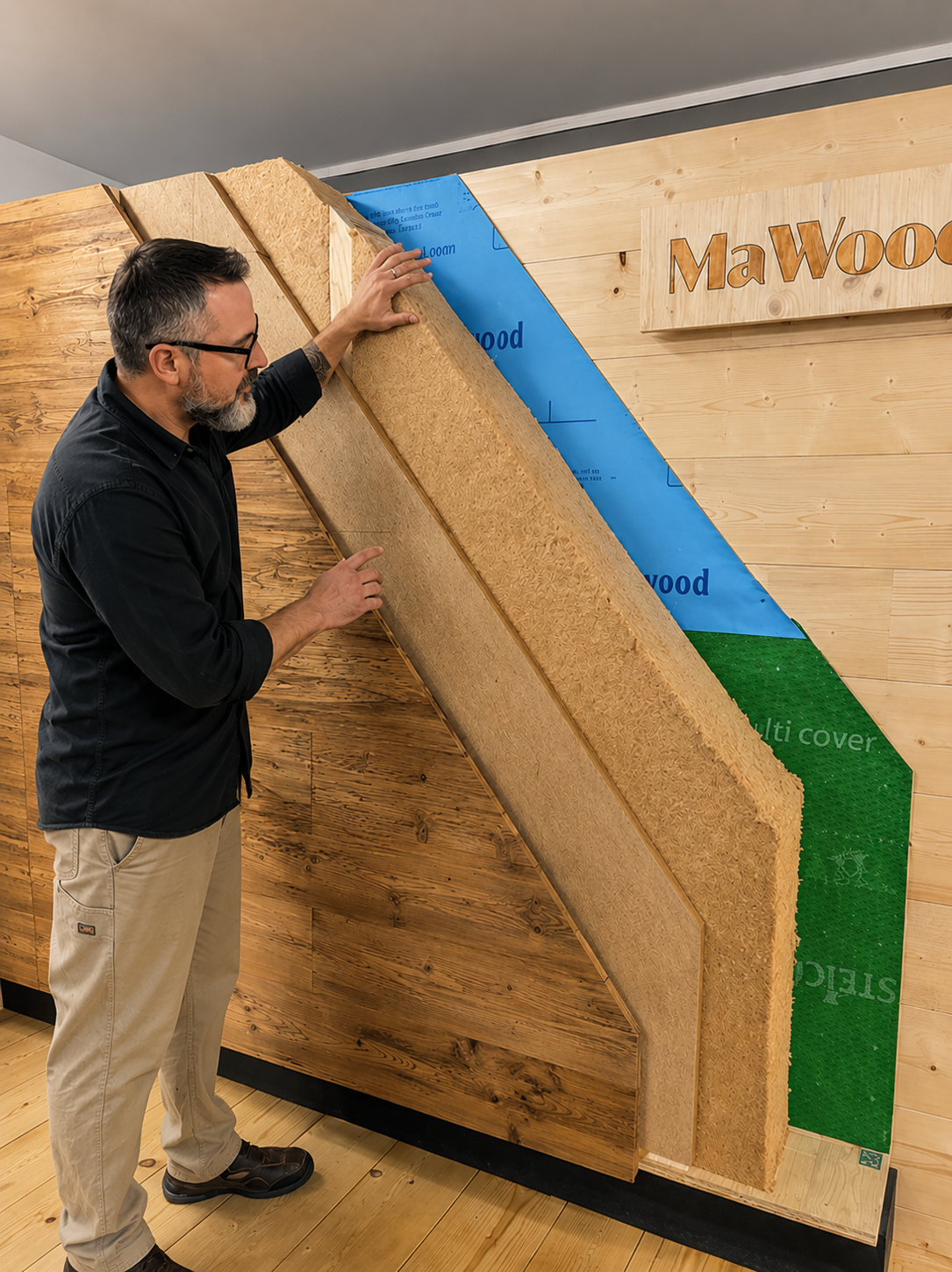
Whether building materials, transport routes or water and electricity use, a resource- and energy-efficient building uses only what it needs. This does not reduce comfort; it can increase it by cutting unnecessary costs during use. Water-saving fittings that reduce flow rates are one example worth planning.
Energy efficiency is the largest factor, as energy supply accounts for much of the running costs. An efficient building reduces energy consumption through good insulation, efficient heating and cooling systems, and the use of renewable energy sources.
The type of window glazing also matters, because windows represent unavoidable thermal bridges whose effects should be minimised. The system can additionally be supported by photovoltaics or geothermal heat generation to increase independence and protect the environment. Combined with sensible storage methods, this can improve the home’s self-sufficiency . These measures also provide security in an age of centralised supply that is otherwise difficult to achieve.
Everything under one roof with MaWood-Home®
Healthy, sustainable building ultimately requires careful planning and implementation if a building is to support its users’ health and quality of life in the long term. Integrating expertise in energy generation and materials from the planning stage helps achieve this goal. After all: A home is the largest investment in most people’s lives. Optimising it throughout its use to support health, wellbeing and household finances can turn a family home into an oasis of wellbeing that houses generations and keeps them healthy over the long term. MaWood-Home® brings all this under one roof.
Motivated to explore new approaches and improve building’s environmental compatibility, we set out to revolutionise the conventional family home. This is possible because we build sustainably and healthily . We calculate our buildings meticulously and now demonstrably achieve consumption close to passive-house standards. As described above, however, we need no ventilation system, unlike the requirement in passive-house construction. To document performance, our buildings receive an energy performance certificate. This calculation-based simulation estimates the home’s energy needs during use, allowing us to determine before construction how much energy is needed to maintain a healthy indoor climate over the long term.
BUILDING WITH TIMBER AND CLAY